Written by Jeff Andrade, Founder of Tour Hub Pro and 17-year water sports operator, St. Kitts.
Table of Contents
- The List You Already Have
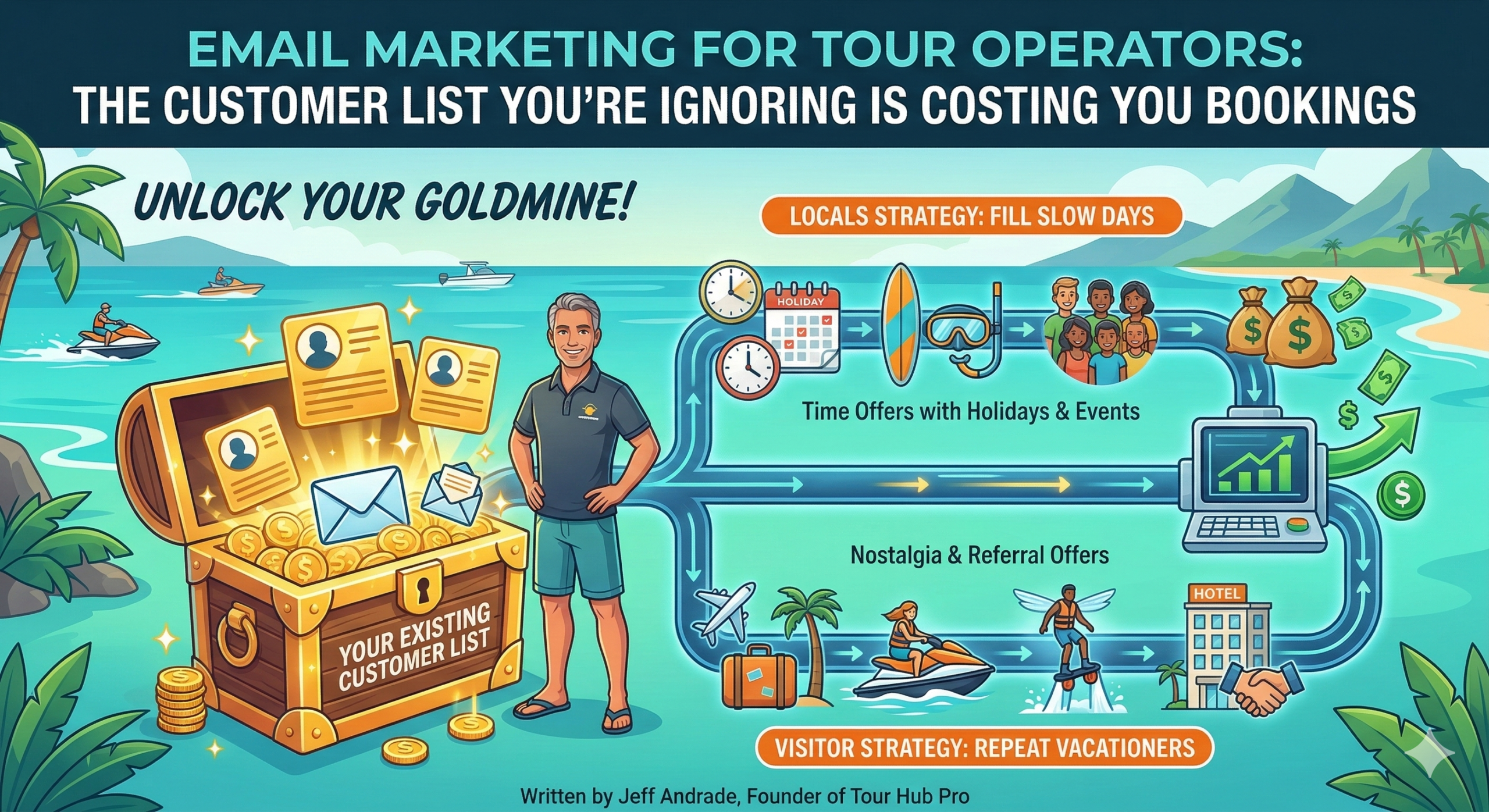
- Two Segments, Two Completely Different Strategies
- The Visitor Strategy: Turn Past Guests Into Repeat Vacationers
- The Local Strategy: Fill Slow Days With People Who Already Like You
- Why Most Operators Quit Too Early
- What to Actually Write in Your Emails
- How Tour Hub Pro Makes This Easier
- Frequently Asked Questions
The List You Already Have
After 17 years running St. Kitts Water Sports, I have over 50,000 customers in my database. I didn’t buy that list. I didn’t run ads to build it. Every single person on it chose to do business with me at some point. They got on a jet ski, went snorkeling, booked a flyboard session, or came on a tour. They already know who we are.
That list is one of the most valuable assets my business owns. And for years, I barely used it.
When I finally started emailing that list consistently, it changed how I thought about marketing entirely. You don’t always need to find new customers. Sometimes the best customers you’ll ever have are the ones who already love what you do. You just have to remind them you exist.
Two Segments, Two Completely Different Strategies
One of the biggest mistakes operators make with email is treating everyone on their list the same. A tourist from Canada who visited St. Kitts on a cruise two years ago needs a completely different message than a local who lives 15 minutes from the beach.
We split our list into two groups: visitors and locals. The strategy for each one is completely different, and that separation is what makes our emails actually land.
The Visitor Strategy: Turn Past Guests Into Repeat Vacationers
Visitors are people who came to St. Kitts, loved it, and went home. They are not going to book a kayak tour next Tuesday. But they might come back. And they almost certainly know someone who is planning a Caribbean vacation right now.
Our visitor emails do two things. First, we plant the seed of a return trip. We remind them what they loved about being here and paint the picture of coming back. Second, we ask for referrals. We tell them straight up: if you know anyone heading to St. Kitts, send them our way. We’ll take care of them, and we’ll take care of you too, either with a commission or a discounted rate for their friends.
The campaign that really opened my eyes to what was possible came when we stopped selling individual activities and started packaging things together. We put together a full vacation package: flights, a hotel stay nearby where we had negotiated a 20% referral commission, and a bundle of our activities. We emailed our past visitor list and presented the whole thing. One family of four who had visited us during a cruise and loved St. Kitts took us up on it. They booked the full package.
That single campaign generated $1,500 in profit. The best part was that we added those four people to tours that were already going out, so the incremental cost to us was almost nothing. The hotel commission took care of itself. That booking proved to me that your visitor list, treated correctly, is worth serious money.
The Local Strategy: Fill Slow Days With People Who Already Like You
Local customers are a completely different animal. They are not planning a vacation. But they do get bored. They have days off. They want something fun to do on a long weekend, during a public holiday, or just on a slow Saturday with friends.
Our local email strategy is simple: target their downtime at exactly the right moment and make the offer easy to say yes to.
We email our local list more frequently than our visitor list and time it around holidays and events when we know people have free time. We offer discounted group rates. If you can fill a tour with locals who got a deal, you still come out ahead because the tour is going out anyway and those extra seats are pure margin.
To sweeten the offer, we bundle in things that feel like value to the customer but cost us almost nothing to deliver: snorkeling, paddleboarding, kayaking. Stuff we have sitting there. To someone who doesn’t own the equipment, a free paddleboard add-on feels like a real perk. To us, it costs nothing extra.
Our first local campaign that actually produced results came around the fourth or fifth send. We made about $300 on that one. Not life-changing money, but proof the list was responding. From there it built.
Why Most Operators Quit Too Early
Here is the honest truth about why email marketing fails for most tour operators: they send two or three emails, get nothing back, and conclude that it doesn’t work. I felt the same way when I started.
For us, it took nine or ten campaigns before we landed that first vacation package booking. Nine or ten. Most operators would have stopped at two.
Email is not a one-shot channel. It is a consistency game. The operators who stick with it get better at writing offers. They learn what their list responds to. They figure out which subject lines actually get opened. And eventually, it starts working.
The copy and offers you write on your ninth campaign are a lot better than the ones you wrote on your first. You only get there by doing it. If you quit after three emails because the silence feels like rejection, you never find out what your list is actually worth.
The other thing that has changed dramatically is the tools available now. With AI, crafting a compelling email that sounds personal and professional takes ten minutes. There is no excuse anymore for not doing this consistently.
What to Actually Write in Your Emails
For visitor emails, lead with nostalgia and a reason to act. Remind them of the experience they had. Give them a reason to either come back or pass you along to someone who is heading your way. A referral offer with a real incentive works far better than a generic “tell your friends about us.”
For local emails, lead with the occasion and make the value obvious fast. People decide quickly whether an email is worth reading. If you are targeting a public holiday, say it upfront. “Got Monday off? Here’s how to make it worth it.” Then get straight to the offer. Group rate, what’s included, how to book.
A few things that work across both lists:
- Keep it short. Nobody reads a long marketing email. Three paragraphs or less.
- One offer per email. Make one clear offer and one clear call to action. Too many choices kill conversions.
- Make it feel personal. Write like you are talking to one person. “Hey, I wanted to reach out personally…” lands better than “Dear valued customer.”
- Send it at the right time. For locals, the day before or morning of a public holiday. For visitors, during peak travel planning season.
How Tour Hub Pro Makes This Easier
The reason most operators never actually do this is not that they don’t want to. It’s that their customer data is scattered across booking forms, spreadsheets, and old email threads. There’s no clean list to email. No way to segment locals from visitors. No history of what each customer did or when they last visited.
Tour Hub Pro has a built-in CRM that keeps all of that in one place. Every customer who books through your system is automatically stored with their full history. You can tag them, segment them, and send targeted emails directly from the platform. No exporting to spreadsheets. No third-party tool to connect and sync. It’s all there.
When I started using a proper system to manage my customer list, the quality of my campaigns improved immediately. I could see who had visited recently, who hadn’t been back in two years, and who had done multiple tours. That context changes what you write and who you write it to.
If you are running your customer list out of a booking confirmation inbox and a few spreadsheets, you are leaving serious money on the table. Ready to see how it works? Book a demo and we’ll show you the CRM in action.
Frequently Asked Questions About Email Marketing for Tour Operators
How often should tour operators send marketing emails?
For a local customer list, once or twice a month is reasonable, especially timed around holidays, long weekends, or local events. For a visitor list, once a month or once a quarter is enough. The key is relevance over volume. A well-timed email with a strong offer beats five generic ones every time.
What should a tour operator include in a marketing email?
One clear offer, a reason to act now (a date, a holiday, limited availability), and one call to action. For visitor lists, include a referral angle with a real incentive. For local lists, lead with the event or occasion and make the group deal obvious. Keep it short, keep it personal, and get to the point in the first two sentences.
Does email marketing actually work for tour operators?
Yes, but it takes consistency. Most operators give up after two or three emails with no response and conclude it doesn’t work. In practice, it can take eight to ten campaigns before you land a meaningful booking from email alone. The operators who stick with it develop better offers and better copy over time, and the results compound. A past guest who books a return trip or refers a friend is one of the highest-value conversions a tour business can generate.
How do I grow my email list as a tour operator?
Your booking process is the most reliable list-builder you have. Every customer who books should have their email captured and stored in your system automatically. Walk-in customers and phone bookings should be captured too. Most operators already have a larger list than they realize. The problem is usually that the data is scattered, not that it doesn’t exist.
Should I segment my email list as a tour operator?
Absolutely. The minimum segmentation worth doing is local customers versus visitors, because the right message for each group is completely different. Locals need offers that target their free time and fit into their daily lives. Visitors need reasons to come back or refer friends. Sending the same email to both groups means neither message lands as well as it could. Tour Hub Pro lets you tag and segment customers without any manual effort.
Leave a Reply